Monday, May 8, 2017

Resep Maki Zushi (Sushi Gulung)

Bahan-bahan untuk Sushi Gulung (untuk 4 porsi):

360 ml (300 g)
400 ml air
(cuka Sushi)
3 sendok makan cuka
2 sendok makan gula
1 sendok teh garam

1 wortel (100 g)
1 sendok makan gula
1/4 sendok teh garam
200 ml air                                                               
2 telur ayam
1 sendok makan gula
garam secukupnya
1/2 sendok teh kecap asin Jepang
1 sendok makan air
1 sendok teh minyak

1 mentimun
70 g ikan (tuna) kalengan
4 lembar nori/rumput laut (bentuk kotak yang tiap sisi panjangnya sekitar 20 cm)

Persiapan

  1. Buatlah nasi yang diberi cuka beras. Mohon merujuk ke laman program ini di bawah resep Ayam Teriyaki, untuk melihat cara memasak nasinya.
  2. Sekarang buat cuka sushi. Masukkan cuka, gula dan garam ke dalam panci masak kecil lalu kocok rata.
  3. Masukkan nasi yang baru dimasak ke dalam cawan, masukkan cuka sushi lalu aduk selama satu atau dua menit. Begitu nasi dan cuka sushinya sudah tercampur, kipas-kipas dan dinginkan nasinya, lalu pisahkan menjadi empat bagian yang sama besar.
  4. Kupas wortel lalu potong menjadi batang berdiameter 1 cm. Masukkan potongan wortel ke dalam panci lalu masak dengan api sedang. Setelah airnya mendidih, kecilkan apinya dan masak selama 5 menit. Setelah 5 menit, masukkan gula dan garam, pasang kembali penutup panci lalu teruskan masak selama 7 menit lagi. Matikan api, biarkan dingin agar wortel menyerap bumbu-bumbunya.
  5. Masak telur dadar tamago-yaki. Masukkan gula, garam, kecap asin Jepang serta air ke dalam cawan lalu aduk rata. Pecahkan telur ke dalam cawan yang berbeda lalu kocok rata. Tambahkan bumbu yang baru Anda aduk. Panaskan panci penggorengan dengan api sedang, tuangkan minyak dengan merata, lalu masukkan campuran telur sekaligus, lalu aduk dengan cepat. Saat campuran telurnya sudah setengah matang, angkat pegangan panci penggorengan lalu miringkan menjauh dari Anda agar telurnya merosot ke tepi, lalu bentuklah menjadi telur dadar. Kecilkan api dan masak hingga matang sepenuhnya. Begitu telur dadar sudah dingin, potong-potong menjadi batang-batang berdiameter 1 cm.
  6. Potong timun menjadi batang-batang berdiameter 1 cm juga.
  7. Masukkan tuna ke dalam saringan lalu tiriskan.
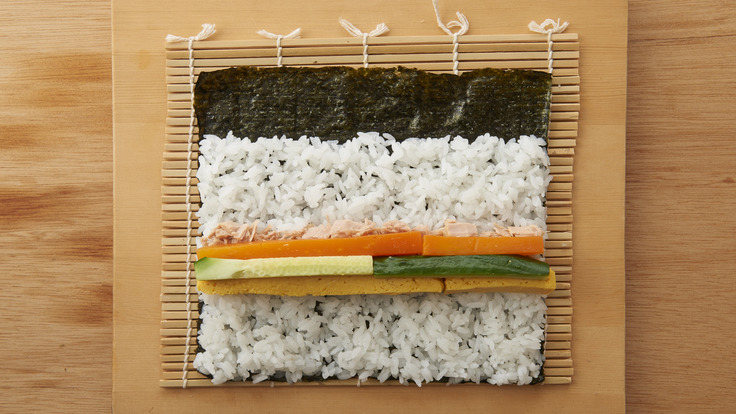
  8. Gelar tikar penggulung sushi atau kain yang kuat, lalu letakkan lembaran nori di atasnya. Lembabkan tangan Anda, lalu lap sedikit dengan handuk tangan. Ambil salah satu dari seperempat porsi nasi yang sudah diberi cuka beras, lalu sebarkan merata di atas nori, dengan meninggalkan jeda berdiameter sekitar 5 cm tanpa nasi di ujung nori.
  9. Begitu nasi yang sudah diberi cuka beras disebar merata, letakkan isi di atas nasi di baris tengah. Isi yang lebih lembut diletakkan lebih dahulu. Telur dadar diletakkan di sebelah tuna. Wortel dan timun di atas tuna dan telur.
  10. Gunakan kedua jempol untuk mengangkat bagian dekat ujung tikar penggulung, dan jari-jari lainnya untuk menahan isi agar tetap pada tempatnya. Angkat tepi yang dekat dengan kita ke arah tepi yang jauh dari kita untuk menangkupnya. Gulung menjadi bentuk silinder, lalu gulung maju mundur sedikit agar membuat bentuk yang baik. Letakkan gulungan yang sudah jadi dengan ujung gulungan menghadap ke bawah. Gulung tiga gulungan berikutnya dengan cara yang sama.
Resep masakan Jepang lainnya:
Ayam Teriyaki Rendah Garam
Hipari Udon dan Kayaki
Temakizushi
Burger Kedelai
Koraku Bento
Tatsuta-Age
Hiyajiru (sup dingin)
Yasaino Tempura (Tempura sayuran)
Agebitashi
Namasu
Chankonabe
Anpan (Roti kacang merah)
Kabocha purin
Furikake
Imo-ni (Talas dalam mangkok panas)
Kinoko gohan (Nasi jamur)
Karinto (Semacam kue gemblong)
Sup Suiton
Agedashi dofu
Doraikare (kare kering)
Kuriimu korokke (kroket krim)
Wafu Sarada


Monday, July 25, 2016

How to make Bloody Maria

Ingredients

2 cups organic low-sodium vegetable juice (such as R.W. Knudsen)
½ cup salsa (mild, medium, or hot)
4 oz. English cucumber (about 1/3 of a medium cucumber), peeled, halved lengthwise, seeds removed, chopped
2 Tbsp. lime juice (from 1 to 2 limes), plus extra limes for garnish (optional)
Salt and freshly ground black pepper
Honey, optional
Hot sauce, optional

Preparation

1. In a blender, combine vegetable juice, salsa, cucumber and lime juice; blend until well combined and smooth.
2. Taste and season generously with salt and pepper. Blend again.
3. Add honey 1 tsp. at a time, if needed to balance flavor.
4. Add hot sauce, if desired.
5. To serve, pour ½ to 1 oz. tequila into a highball glass (ice is optional).
6. Top with ½ to 1 cup juice mixture. Garnish with lime, if desired.

Wednesday, June 29, 2016

Jomblo itu baik untuk kesehatan

Jomblo alias belum mempunyai pasangan hidup ternyata seringkali mengganggu aktifitas seseorang di kehidupan sosial Bisa jadi jomblo dari seseorang bisa dianggap tabu, juga tak sedikit orang saat belum memiliki pasangan merasa iri dan sedih karena melakukan segalanya sendiri. Meski tak sedikit pula yang menikmati kesendirian sebagai bentuk kebebasan diri melakukan segala hal, dan merasa bahagia. Beberapa dari para single pun seringkali mengungkapkan bahwa lebih baik sendiri ketimbang berada dalam hubungan berkualitas buruk.

Thursday, June 23, 2016

Manfaat minum kopi untuk kesehatan tubuh

Kopi adalah minuman hasil seduhan biji kopi yang telah disangrai dan dihaluskan menjadi bubuk.[2] Kopi merupakan salah satu komiditas di dunia yang dibudidayakan lebih dari 50 negara. Dua varietas pohon kopi yang dikenal secara umum yaitu Kopi Robusta (Coffea canephora) dan Kopi Arabika (Coffea arabica).

Saturday, May 28, 2016

Manfaat tidur tanpa BH

Tubuh mengistirahatkan kerja berbagai organ tubuh yang ikut bekerja keras seharian. Tidak mungkin seseorang dapat terus-terusan bekerja tanpa istirahat, karena kita butuh saat pemulihan tubuh menjadi segar kembali yaitu tidur. Manfaat tidur secara garis besar ialah untuk pemulihan tubuh dan berbagai kondisi kesehatan lainnya.

Wednesday, December 17, 2014

Pil ajaib bikin kentut jadi wangi

Siapa anda, anda pasti akan bersungut-sungut bila ada seorang yang kentut dengan bau yang tak sedap. Bagaimanapun juga kentut adalah sesuatu yang alami dimana semua orang pernah kentut. Kentut adalah proses pelepasan gas dari sistem pencernaan. Berbahagialah jika Anda bisa kentut setiap hari, tandanya sehat, ya walaupun.. tak semua kentut beraroma menyenangkan.

Saturday, July 26, 2014

Genius Cooking Tips You Need To Try

Anyone who's striving to follow a healthier diet should start by prepping more meals at home. Cooking your own food allows you to control portion sizes and ingredients used, not to mention it saves you money. But there is a learning curve when it comes to all that chopping, slicing, and dicing. That's why we've collected 14 clever tips and tricks for cooking at home from our friends at Food & Wine—no fancy gadgets or chef-worthy knife skills required.

Thursday, July 24, 2014

5 Ways To Cut Your Breast Cancer Risk

1. Limit yourself to two or three alcoholic drinks a week

Alcohol, consumed even in small amounts, is believed to increase the risk of breast cancer. Most doctors recommend cutting back on wine, beer, and hard liquor.

A recent study showed the link between drinking and breast cancer was especially strong in the 70% of tumors known as hormone-sensitive.

Monday, July 21, 2014

Happy life with menopause

Menopause, the cessation of the menstrual cycle, is a natural part of aging in women. Defined as not having a period for at least a year, menopause occurs at an average age of 51, although onset can vary widely.

Wednesday, July 16, 2014

How to treat a vaginal infection with garlic


Garlic kills yeast. Those who bake bread know not to add garlic while the dough is rising or it will kill the yeast. Instead, garlic is added to the dough after it has risen, just before baking it in the oven.
A fresh garlic clove can easily cure a yeast infection. The trick is to catch the infection early. A woman who suffers from frequent yeast infections knows the feeling well. The first day, she feels just a tickle of itchiness that comes and goes. The next day, or sometimes two or three days later, the vaginal discharge starts to look white and lumpy like tiny bits of cottage cheese. By this time, she has a full-blown yeast infection and the lips of the vagina are often red and sore

Saturday, July 12, 2014

Cancer-Fighting Culinary Spices and Herbs

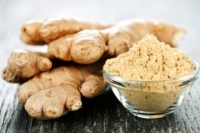
Ginger

Ginger has long been used in folk medicine to treat everything from colds to constipation. Ginger can be used fresh, in powdered form (ginger spice), or candied. Although the flavor between fresh and ground ginger is significantly different, they can be substituted for one another in many recipes. In general, you can replace 1/8 teaspoon of ground ginger with 1 tablespoon of fresh grated ginger, and vice versa.
Consuming ginger and ginger products, in addition to taking any anti-nausea medications as prescribed, may provide some comfort for a queasy stomach during cancer treatment.

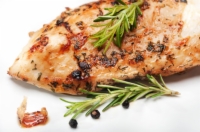
Rosemary
Rosemary is a hearty, woody Mediterranean herb that has needlelike leaves and is a good source of antioxidants. Because of its origin, rosemary is commonly used in Mediterranean cooking and you’ll often see it included as a primary ingredient in Italian seasonings. You can use it to add flavor to soups, tomato-based sauces, bread, and high-protein foods like poultry, beef, and lamb.
Rosemary may help with detoxification; taste changes; indigestion, flatulence, and other digestive problems; and loss of appetite. Try drinking up to 3 cups of rosemary leaf tea daily for help with these problems.
 
Turmeric
Turmeric is an herb in the ginger family; it's one of the ingredients that make many curries yellow and gives it its distinctive flavor. Curcumin appears to be the active compound in turmeric. This compound has demonstrated antioxidant and anti-inflammatory properties, potentially protecting against cancer development.
Turmeric extract supplements are currently being studied to see if they have a role in preventing and treating some cancers, including colon, prostate, breast, and skin cancers. Although results appear promising, they have largely been observed in laboratory and animal studies, so it’s unclear whether these results will ultimately translate to humans.

Chile Pepper
Chile peppers contain capsaicin, a compound that can relieve pain. When capsaicin is applied topically to the skin, it causes the release of a chemical called substance P. Upon continued use, the amount of substance P eventually produced in that area decreases, reducing pain in the area.
But this doesn’t mean you should go rubbing chile peppers where you have pain. Chile peppers need to be handled very carefully, because they can cause burns if they come in contact with the skin.
Therefore, if you have pain and want to harness the power of chile peppers, ask your oncologist or physician about prescribing a capsaicin cream. It has shown pretty good results with regard to treating neuropathic pain (sharp, shocking pain that follows the path of a nerve) after surgery for cancer.
Another benefit of chile peppers is that they may help with indigestion. Seems counterintuitive, right? But some studies have shown that ingesting small amounts of cayenne may reduce indigestion.
 
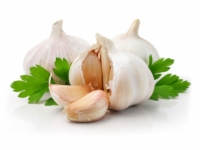
Garlic
Garlic belongs to the Allium class of bulb-shaped plants, which also includes chives, leeks, onions, shallots, and scallions. Garlic has a high sulfur content and is also a good source of arginine, oligosaccharides, flavonoids, and selenium, all of which may be beneficial to health. Garlic’s active compound, called allicin, gives it its characteristic odor and is produced when garlic bulbs are chopped, crushed, or otherwise damaged.
Several studies suggest that increased garlic intake reduces the risk of cancers of the stomach, colon, esophagus, pancreas, and breast. It appears that garlic may protect against cancer through numerous mechanisms, including by inhibiting bacterial infections and the formation of cancer-causing substances, promoting DNA repair, and inducing cell death. Garlic supports detoxification and may also support the immune system and help reduce blood pressure.

Peppermint
Peppermint is a natural hybrid cross between water mint and spearmint. It has been used for thousands of years as a digestive aid to relieve gas, indigestion, cramps, and diarrhea. It may also help with symptoms of irritable bowel syndrome and food poisoning. Peppermint appears to calm the muscles of the stomach and improve the flow of bile, enabling food to pass through the stomach more quickly.
If your cancer or treatment is causing an upset stomach, try drinking a cup of peppermint tea. Many commercial varieties are on the market, or you can make your own by boiling dried peppermint leaves in water or adding fresh leaves to boiled water and letting them steep for a few minutes until the tea reaches the desired strength.
Peppermint can also soothe a sore throat. For this reason, it is also sometimes used to relieve the painful mouth sores that can occur from chemotherapy and radiation, or is a key ingredient in treatments for this condition.

Chamomile
Chamomile is thought to have medicinal benefits and has been used throughout history to treat a variety of conditions. Chamomile may help with sleep issues; if sleep is a problem for you, try drinking a strong chamomile tea shortly before bedtime.
Chamomile mouthwash has also been studied for preventing and treating mouth sores from chemotherapy and radiation therapy. Although the results are mixed, there is no harm in giving it a try, provided your oncologist is not opposed. If given the green light, simply make the tea, let it cool, and rinse and gargle as often as desired.
Chamomile tea may be another way to manage digestive problems, including stomach cramps. Chamomile appears to help relax muscle contractions, particularly the smooth muscles of the intestines.
(source: Dummies.com)


Friday, July 11, 2014

Why you're always tired?

by Linda Melone
Lack of sleep isn't the only thing sapping your energy. Little things you do (and don't do) can exhaust you both mentally and physically, which can make getting through your day a chore. Here, experts reveal common bad habits that can make you feel tired, plus simple lifestyle tweaks that will put the pep back in your step.


  1. You skip exercise when your tired.  Skipping your workout to save energy actually works against you. In a University of Georgia study, sedentary but otherwise healthy adults who began exercising lightly three days a week for as little as 20 minutes at a time reported feeling less fatigued and more energized after six weeks. Regular exercise boosts strength and endurance, helps make your cardiovascular system run more efficiently, and delivers oxygen and nutrients to your tissues. So next time you're tempted to crash on the couch, at least go for a brisk walk—you won't regret it.
  2. You don't drink enough water.  Being even slightly dehydrated—as little as 2% of normal fluid loss—takes a toll on energy levels, says Amy Goodson, RD, a dietitian for Texas Health Ben Hogan Sports Medicine. Dehydration causes a reduction in blood volume, explains Goodson, which makes the blood thicker. This requires your heart to pump less efficiently, reducing the speed at which oxygen and nutrients reach your muscles and organs. To calculate your normal fluid needs, take your weight in pounds, divide in half and drink that number of ounces of fluid a day, Goodson recommends.
  3. You're not consuming enough iron.  An iron deficiency can leave you feeling sluggish, irritable, weak, and unable to focus. "It makes you tired because less oxygen travels to the muscles and cells," says Goodson. Boost your iron intake to reduce your risk of anemia: load up on lean beef, kidney beans, tofu, eggs (including the yolk), dark green leafy vegetables, nuts, and peanut butter, and pair them with foods high in vitamin C (vitamin C improves iron absorption when eaten together), suggests Goodson. Note: an iron deficiency may be due to an underlying health problem, so if you're experiencing these symptoms of iron deficiency, you should visit your doc.
  4. You are perfectionist.  Striving to be perfect—which, let's face it, is impossible—makes you work much harder and longer than necessary, says Irene S. Levine, PhD, professor of psychiatry at the New York University School of Medicine. "You set goals that are so unrealistic that they are difficult or impossible to achieve, and in the end, there is no sense of self-satisfaction." Levine recommends setting a time limit for yourself on your projects, and taking care to obey it. In time, you'll realize that the extra time you were taking wasn't actually improving your work.
  5. You make mountain out of molehill. If you assume that you're about to get fired when your boss calls you into an unexpected meeting, or you're too afraid to ride your bike because you worry you'll get into an accident, then you're guilty of "catastrophizing," or expecting that the worst-case scenario will always occur. This anxiety can paralyze you and make you mentally exhausted, says Levine. When you catch yourself having these thoughts, take a deep breath and ask yourself how likely it is that the worst really will happen. Getting outdoors, meditating, exercising, or sharing your concerns with a friend may help you better cope and become more realistic.
  6. You skip breakfast. The food you eat fuels your body, and when you sleep, your body continues using what you consumed at dinner the night before to keep your blood pumping and oxygen flowing. So, when you wake up in the morning, you need to refuel with breakfast. Skip it, and you'll feel sluggish. "Eating breakfast is like starting a fire in your body by kickstarting your metabolism," Goodson says. Goodson recommends a breakfast that includes whole grains, lean protein, and healthy fat. Good examples include oatmeal with protein powder and a dab of peanut butter; a smoothie made with fruit, protein powder, low-fat milk, and almond butter; or eggs with two slices of whole-wheat toast and low-fat Greek yogurt.
  7. You live on junk food. Foods loaded with sugar and simple carbs (like the ones you'll find in a box or at the drive-thru window) rank high on the glycemic index (GI), an indicator of how rapidly carbohydrates increase blood sugar. Constant blood sugar spikes followed by sharp drops cause fatigue over the course of the day, says Goodson. Keep blood sugar steady by having a lean protein along with a whole grain at every meal, says Goodson. Good choices include chicken (baked, not fried) and brown rice, salmon and sweet potato, or salad with chicken and fruit. 
  8. You have trouble saying 'no'. People-pleasing often comes at the expense of your own energy and happiness. To make matters worse, it can make you resentful and angry over time. So whether it's your kid's coach asking you to bake cookies for her soccer team or your boss seeing if you can work on a Saturday, you don't have to say yes. Train yourself to say 'no' out loud, suggests Susan Albers, a licensed clinical psychologist with Cleveland Clinic and author of Eat.Q.: Unlock the Weight-Loss Power of Emotional Intelligence. "Try it alone in your car," she says. "Hearing yourself say the word aloud makes it easier to say it when the next opportunity calls for it."
  9. You have a lot of messy. A cluttered desk mentally exhausts you by restricting your ability to focus and limits your brain's ability to process information, according to a Princeton University study. "At the end of each day, make sure your work and personal items are organized and put away," suggests Lombardo. "It will help you have a positive start to your day the next morning." If your office needs major reorganizing, avoid becoming totally overwhelmed by taking it one step at a time: start by tidying what you can see, then move through your desk and cabinets drawer by drawer.
  10. You work through vacation. Checking your email when you should be relaxing by the pool puts you at risk of burnout, says Lombardo. Unplugging and allowing yourself to truly unwind allows your mind and body to rejuvenate and return to the office stronger. "When you truly take breaks, you will be more creative, productive, and effective when you return," says Lombardo.
  11. You have a glass of alcohol before sleep. A nightcap sounds like a good way to unwind before falling asleep, but it can easily backfire. Alcohol initially depresses the central nervous system, producing a sedative effect, says Allen Towfigh, MD, medical director of New York Neurology & Sleep Medicine, P.C., in New York City. "But it ultimately sabotages sleep maintenance." Alcohol creates a rebound effect as it's metabolized, which creates an abrupt surge in the adrenaline system, he says. This is why you're more likely to wake up in the middle of the night after you've been drinking. Dr. Towfigh recommends stopping all alcohol three to four hours before bedtime.
  12. You rely on caffeine to get through the the day. Starting your morning with a java jolt is no big deal—in fact, studies show that up to three daily cups of coffee is good for you—but using caffeine improperly can seriously disrupt your sleep-wake cycle, says Dr. Towfigh. Caffeine blocks adenosine, the byproduct of active cells that drives you to sleep as it accumulates, he explains. A study published in the Journal of Clinical Sleep Medicine revealed that consuming caffeine even six hours prior to bedtime affects sleep, so cut yourself off by mid-afternoon and watch out for these surprising sources of caffeine. 
  13. Stay up late on weekends.  Burning the midnight oil on Saturday night and then sleeping in Sunday morning leads to difficulty falling asleep Sunday night—and a sleep-deprived Monday morning, says Dr. Towfigh. Since staying in can cramp your social life, try to wake up close to your normal time the following morning, and then take a power nap in the afternoon. "Napping for 20 minutes or so allows the body to recharge without entering the deeper stages of sleep, which can cause you to wake up more tired," he says.
  14. Everyone gets distracted occasionally, but if you have real trouble with impulsive behavior, or an inability to pay attention or sit still, you could have attention deficit hyperactivity disorder (ADHD). 

Thursday, July 10, 2014

14 ways to make your beauty

How old are you, really?

The answer is more complicated than counting the number of candles you blew out on your last birthday cake. Your daily habits can either add or subtract years from your life—like how much you exercise, or how stressed you allow yourself to be. Read on for 14 things you can start doing today to live a longer, healthier life. 

  1. Drop some pounds. Being obese increases the risk of diabetes, cancer and heart disease, possibly shaving up to 12 years off your life, per an analysis in the journal Obesity. But being too thin can hike your risk of osteoporosis and poor immune function. So aim to stay at a weight that's healthy for you.
  2. Regularly exceeding one drink a day or three in one sitting can damage organs, weaken the immune system and increase the risk of some cancers.
  3. Easy your stress.Chronic stress makes us feel old—and actually ages us: In a 2012 study, Austrian researchers found that work-related tension harms DNA in our cells, speeding up the shortening of telomeres—which protect the ends of our chromosomes and which may indicate our life expectancy. Of course, it's impossible to completely obliterate stress. "What's important is how you manage it," says Thomas Perls, MD, associate professor at Boston University school of Medicine and creator of the Living to 100 Life Expectancy Calculator. Practice yoga, pray, meditate, relax in the shower or do whatever else chills you out.
  4. Keep learning.  Having more education lengthens your life span, according to a study in the journal Health Affairs, for a number of reasons. Extra schooling may help you become better informed about how to live a healthy life. And educated folks, as a group, have a higher income, which means greater access to good health care and insurance.
  5. Connect.  More and more research points to the value of having friends, and not just on Facebook. An Oxford University study found that being married makes you less likely to die of heart disease, which researchers suggest may be due to partners encouraging the other to seek early medical treatment. Same goes for friendships: Australian research showed that people with the most buddies lived 22 percent longer than those with the smallest circle. "Having positive, meaningful, intimate relationships is critical to most people's well-being," says Linda Fried, MD, dean of Columbia University's Mailman School of Public Health.
  6. Extend a hand.  Volunteering is linked to a lower risk of death, a University of Michigan study suggests. But you don't have to log hours at a soup kitchen: Simply helping friends and family—say, by tutoring your niece or assisting your neighbor with her groceries—lowers blood pressure, according to researchers at the University of Tennessee and Johns Hopkins University.
  7. Work out often. Exercising regularly—ideally at least three days of cardio and two days of strength training a week—may help slow the aging process, Canadian doctors reported. "Being physically active is like keeping the car engine tuned," Dr. Fried says. "Even if there's decline with age, it's less severe." You were never an athlete? Don't worry: Starting to work out now can reduce your likelihood of becoming ill going forward, a 2014 study suggests.
  8. Consider your protein. A diet rich in processed meat—including hot dogs, sausage, cured bacon and cured deli meats—has been linked to a higher risk of heart disease, diabetes and colon cancer. Limit your intake as much as possible.
  9. Give up smoking. Lighting up increases your risk of not only lung cancer but also heart disease and cancer of almost every other organ. "Just one cigarette a day can take 15 years off your life," Dr. Perls says. Though you won't instantly revert to pre-smoking health, kicking butts will cut your added cardiovascular risk in half after a year and to that of a nonsmoker after 15. 
  10. Enjoy your life.  Good news for java lovers: Research indicates that drinking it regularly may protect against diabetes, cirrhosis and liver cancer. And Harvard research suggests that drinking 3 1/2 cups a day may lower risk of heart disease. Read more about the health benefits of coffee. 
  11. Sleep better.  For evidence that you can—and should—make slumber a priority, look no further than a 2013 study from the University of Surrey in England, which compared a group who got less than six hours of sleep a night with a group who got 8 1/2 hours. After just one week, snoozing less had altered the expression of 711 genes, including ones involved in metabolism, inflammation and immunity, which may raise the risk of conditions from heart disease to obesity.
  12. Have more sex.The feel-good rush you get from it helps you fight stress and depression, jolt the immune system and lower blood pressure. 
  13. Go Mediterranean. In a 2013 Annals of Internal Medicine study, women who followed a Mediterranean-style diet were 40 percent more likely to live past 70 without major chronic illness than those with less healthy diets. Eat lots of veggies, fruit, fish and whole grains, and avoid simple carbs, such as pasta and sugar ("age accelerators," Dr. Perls calls them). Try these Mediterranean diet recipes. 
  14. Know your history. Have one or more relatives who lived into their 90s? You may be genetically blessed. But that doesn't mean you should quit the gym and live on doughnuts. "Before you get to extreme ages, healthy lifestyle is more critical than genes," Dr. Perls says. So thank your ancestors, but stick to vegetables and cardio as life insurance. 


Wednesday, July 9, 2014

How to Losing Weight Without Trying

Painless weight loss tricks

Meticulous meal planning. Counting every calorie you consume. Spending an entire weekend cooking healthy meals for the following week. Finding even more time to exercise. Sure, these weight-loss strategies work, but they can be awfully time consuming. Enter our slacker's guide to weight loss. The following 16 no-effort tweaks can be applied to your current routine instantly. 


Indulge your Candy Crush addiction

Turns out playing video games reduces the vividness and frequency of cravings compared with waiting it out, according to new research in the journal Appetite. (Study participants played Tetris.) Why? Because playing games distracts your laser focus on about that pint of ooey-gooey chocolate ice cream sitting in your freezer. 

Keep good food close

Laziness plays a bigger role in your food choices—both good and bad—than you might think, suggests another study published in Appetite. Undergraduates at Saint Bonaventure University in Upstate New York were separated into three groups: one that sat with apple slices within reach and buttered popcorn roughly six feet away, one with the popcorn within reach and the apple slices six feet away, and one with both snacks within reach. Even though the participants told the researchers they preferred to eat the popcorn over the apples, they ate whatever was nearest to them.

Sleep in

There's no better way to indulge in your lazy tendencies than to get more sleep. Sleeping fewer than than five hours a night could send the scale soaring 30% higher than if you got seven hours or more, suggests a study published in the American Journal of Epidemiology.

Order your drinks unsweetened

"Order a plain latte instead of flavored, plain iced tea, plain coffee," says Beth Saltz, RD. Opting for the plain latte over the flavored will save you 40 calories per 16-ounce serving and forgoing the half and half in your coffee will save you up to 20 calories and 2 grams of fat per one-tablespoon serving of the creamy stuff.

Eat sitting down

"You would be amazed how many calories you consume without paying attention, especially from tray-passed foods and buffets at parties or get-togethers," Saltz says. Mindless eating is the enemy of weight loss. Studies out of Cornell University's Food and Brand Lab show we unconsciously eat more out of bigger containers, and in social situations. "If you're sitting down at a table, though, you will be more mindful of what you are eating and keep extra calories from sneaking in from tray-passed snacks and buffet food," she says. To reduce temptation even more, sit further away from the food.

Save the salad for last

Salad comes with your meal; just eat it at the end of your meal. "Rather than taking seconds of the main course, a salad can be a very filling, low-calorie option," says Debra Wein, RD, president of Wellness Workdays, a leading provider of worksite wellness programs. "By eating it last, it will give your brain a chance to catch up with your stomach so you realize that you aren't as hungry as when you started your meal. Just make sure you skip the creamy dressings." 

Relax

A low-stress lifestyle may keep belly fat away, suggests research published in the journal Psychoneuroendocrinology. For a year, researchers from the University of California at San Francisco followed 61 healthy women; 33 were chronically stressed while the other 28 were not. All were asked to keep a record of their consumption of high sugar, high fat foods. Researchers found that eating these unhealthy foods frequently predicted metabolic risk, including a larger waistline, more belly fat, higher oxidative damage, and more insulin resistance—but only in the high-stress group. Women in the low-stress group who also ate a lot of high fat, high sugar foods did not experience the same negative metabolic effects.

Forget about diet soda

Research out of the University of Texas at Austin found that people who drank diet soda tended to have larger waists. After following 474 people for about a decade, they found that those who drank diet soda had a 70% greater increase in waist circumferences compared with non-drinkers. What's more: people who consumed two or more diet sodas a day saw a 500% greater increase. (Here are 10 more reasons you should give up diet soda.)

Make water your go-to drink

Sure, we've all been told we should make sure to drink enough water, but it bears repeating—research shows it can be an effective weight-loss aid. In one Virginia Tech study, overweight people who followed a low-calorie diet and drank two eight-ounce glasses of water before every meal lost an average of 15.5 pounds over three months. People who reduced their calorie intake but didn't down the H20 dropped just 11 pounds. 

Grab Greek yogurt or cottage cheese for breakfast

Both are easy, no-cook breakfasts that give your body a big dose of calcium and nearly 20 grams of protein, says registered dietician Tiffani Buchus, who is the co-author of No Excuses! 50 Healthy Ways to ROCK Breakfast! In a recent study, women who consumed about 30 grams of protein at breakfast reported feeling fuller for longer and consuming fewer calories at lunch than those who ate just three grams of protein.

Opt for raw

When you're hungry, grabbing a piece of fruit is easy—no cooking is required. "Fruits are naturally sweet, high in fiber, and full of hydration," says Wein. "If you fill up on fruits, you'll be less likely to want to eat other foods." Raw vegetables can have the same effect.

Don't drown your food

Bypassing dips and dressings can help shave off calories. "While a few dabs won't break you, a little here and a little there will jeopardize your weight loss efforts," says Buchus. Most creamy dips can rack up the calorie count to over 100 calories and 10 to 15 grams fat for only four tablespoons.

Limit your frozen yogurt

Are you a fro-yo fiend? Keep your self-serve in check by employing a dollar limit. "Most yogurt is 20 to 30 calories per ounce, so calories add up quickly even before toppings," Saltz says. "If you stay under a certain dollar limit—I suggest $3— you will be sure to also limit your calories. Just weigh your yogurt on the scale at the register and they can easily tell you what amount you've hit. The right amount of yogurt is about a fist-sized portion, and the right amount of topping is thumb-sized."

Feed your salsa or curry obsession

By embracing spicy food, you could be tricking your body into eating less, suggests a study in the June 2014 issue of Appetite. In the small Danish study, adding one gram of red chili pepper to each meal kept participants more satiated and full whether they consumed 100% or only 75% of their daily calories and prevented them from overeating after dinner. You can put this to work for you very easily since one gram is approximately one-fourth of a teaspoon.


Monday, April 28, 2014

Become an Exercise Addict: How to stay motivated

by Amanda MacMillan
We all have friends who, despite hectic schedules, never miss a day at the gym. Who can't stop talking about the next 10K. Who can't stop smiling after yoga class. Sure, they’re a little, well, obsessive about working out. But we envy them! The good news is we all have the potential to become fitness-obsessed, says Tom Holland, a Connecticut-based celebrity fitness trainer, exercise physiologist, and expert in sports psychology. Here are 20 proven ways to make exercise a habit.

Get up earlier

Right this minute, go set your alarm and lay out everything you need for your morning workout  . (Switch on a lamp as soon as your alarm goes off, says fitness blogger Tina Haupert, so you wake up faster.) Working out at the same time every day may help you improve more quickly, a study from the University of North Texas found, and other research has shown that people who exercise in the morning are more likely to stick with their workout than those who exercise later in the day. After all, if you get your sweat session out of the way first thing in the a.m., you won't miss out if unexpected distractions come up later in the day. (And while we're on the subject, skip the snooze button: Research suggests that those extra few minutes in bed may actually make you more tired.) 

Give it six weeks

There's an urban legend that it takes 21 days for something to become a habit, but there's little evidence to back up this claim. For exercise, it's probably more like six weeks, says Rebecca Woll, manager of personal training at Equinox in New York City. "This is when you start to see aesthetic changes in your body," she explains. "Once you see these changes you won't want to go back to the old you!" This is also about the time you'll start to notice the difference in how you feel if you miss a day or two of exercise, and you'll start to appreciate the natural high that comes after a good workout.

Find your niche

So you tried spinning and you hated it, or you hurt yourself on your first day of CrossFit. That doesn't mean that all forms of fitness aren't for you—so get back out there and try a different one. "Find something that makes you tune out and gives you a release from your daily grind," says Woll—whether that means focusing on the ground ahead of you on a trail run, or following the instructor in a Zumba class. "You'll know you found it when you look at the clock and an hour flashes by without you noticing." Holland agrees: "I always tell my clients, 'I don't exercise,'" he says. "I'll go for a run or go to the gym, but I don't think of it as exercise because that suddenly gives it a negative connotation." 

Hire a trainer

Whether you're a total newcomer to the fitness scene or you just need a little motivation and guidance, a personal trainer can help you set goals and develop a plan to make them happen. "People think they can't afford it, but they don't realize that even just one or two sessions with a trainer can be so beneficial," says Holland. "Investing just one or two hundred bucks can go a long way." Plus, a good trainer will also hold you accountable and will motivate you to work your hardest, Holland adds. "It's all about positive reinforcement and being there for the client when they need it." 


Join a club

Working out is more fun with friends—and it's a lot harder to bail on when you've got other people relying on you. "I think that's why groups like CrossFit and Weight Watchers are so successful," says Holland. "It shows the value of the support system, which should be an integral part of any workout plan." Your exercise club could be an entire gym full of people, a regular fitness class where everyone knows your name, or just one exercise buddy who makes sure you're out of bed to meet her for your morning walks. Feeling ambitious? Start a fitness or weight-loss contest with your friends or coworkers, suggests Woll. "A little healthy competition always gets you motivated!" 

Make it convenient

Think about when, where, and how your workout can best (and most easily) fit into your daily routine, says Woll. "You don't want to travel far to get to a gym," for example, she says, "or the likelihood of going will decrease immensely." For some people, a gym near the office will help them squeeze in a workout before work or during their lunch break; for others, working out at home or at a gym near their house is more convenient. (And don't forget about where you'll work out on the weekends!) Plan ahead to make sure you can get everything you need—like clothes and shower supplies—to and from your workouts. Or take a tip from Haupert, who rented a locker at her gym so she could keep her things there all week long. 

Become a groupie

The right teacher can make a fitness class feel more like a party than a workout, whether it's Zumba, spinning or cardio kickboxing. "Finding an instructor is like dating," says Woll. "If the first one doesn't work, keep looking. This person should make you want to come to the gym!" (Just be ready for some competition: Popular fitness instructors see their classes fill up fast, and maintain loyal followings even when they switch class times and locations.) You can even glean workout inspiration from celebrity instructors and trainers. Even if you've never met them in person, following your fitness idols on Facebook, working out to their DVDs or reading their advice in magazines can all be powerful motivators to follow their examples.

Pay for it

"Being accountable with money is a good thing," says Holland, "If you invest in a fitness regimen, you're more likely to work harder to get your money's worth." (He's learned that when he gives away training sessions for free, his clients aren't nearly as motivated.) If you can afford it, joining an upscale gym or splurging on boutique fitness classes could be just the thing you need to force yourself to actually go. Or, bribe yourself with smaller investments—treat yourself to a new pair of running shoes or a new GPS watch, for example.

Don't overdo it

One way to put a stop to your new exercise habit before it even gets off the ground? Getting hurt. Beginners (or people just returning to fitness after a long break) need to be careful about trying to do too much, too soon, which can leave you sore and exhausted—or worse yet, with a real injury that will keep you sidelined for even longer. It's normal to have some muscle aches and stiffness a day or two after working out muscles you haven't used in a while, but if you start to feel sick or overly tired, you could be training too hard. Following a training plan (like a Couch to 5K program) or working with a personal trainer can help you make sure you're progressing at a reasonable pace.

Get techy (and social)

For some people, the feel-good side effects of exercise are enough to keep them going. Others need something a little more tangible to get themselves up and out of bed every morning. If you thrive on statistics and numbers, you may find that using apps, computer programs, or wearable pedometers and fitness trackers can help you stay on track with a new routine. Whether you're counting your daily steps or the number of calories you've burned, technology can help you challenge yourself to new personal bests every day. Plus, many of these programs can be integrated with your social networks, making it easy to let your Facebook feed know that you just ran 3 miles or checked in at the gym. Once your friends start asking you about your new exercise habits, it may be harder to let them fall by the wayside. 

Hold out on yourself

Trick yourself into looking forward to exercise, by making it the only time you treat yourself to something special. Maybe it's a podcast or a playlist of songs that you only listen to you while you run, your favorite TV show that you'll only watch from the treadmill, brunch with girlfriends after yoga class, or a special dessert you only allow yourself on days you've worked out. When you associate exercise with positive experiences, says Holland, you'll start to look at it less as a chore and more as something fun and rewarding.

Count your calories

It's not directly related to exercise, but paying closer attention to what you're putting into your body can make you more aware of how you're treating it, overall. (Keeping a food and fitness diary or using a calorie-tracking app can also remind you of how a few more minutes on the elliptical can help balance out that extra scoop of guacamole.) Plus, a 2013 Stanford University study found that people who adopt a diet and exercise program together are more likely to stick with both new habits than those who tackle an individual goal by itself. 

Set attainable goals

"I think the vast majority of people set the wrong goals—ones that are too ambitious or that can't be quantified" says Holland. Instead, it's important to work toward smaller benchmarks, agrees Woll—losing six pounds in six weeks, for example, or to run a 5K in two months and a half marathon in a year, she says. "Your end goals will change as you reach them, but they always need to be set." To keep yourself on track, keep your goal front and center: Sign up for a race and circle the date on your calendar, or hang up an old pair of pants that you'd like to fit back into three months from now.

Skip the gym

If getting to the gym every day isn't conducive to your schedule (or you just hate the idea of going there, period), don't force it. Thanks to workout DVDs, streaming online classes, and home exercise systems, it's easier than ever to get a great workout without even leaving your house. "A lot of people really like the idea of exercising in the privacy of their own homes, and it can be much easier to fit into a busy schedule," says Holland. Plus, when your workout is staring you in the face—your treadmill in the living room or your P90X chin-up bar hanging from a doorway—it's a lot harder to ignore.

Write it out

A 2002 British study found that when adults were told to keep track of how much they worked out over the next two weeks, those who were first asked to formulate a plan on exactly when and where they would exercise were more likely to exercise at least once a week—91%, versus just 38% of those who hadn't planned ahead. Having a schedule and figuring out the logistics ahead of time will give you fewer obstacles (like forgetting your sneakers or double-booking yourself) on the day of your workout.

Make it a ritual

The most important thing about establishing a regular routine, whether it's exercise or anything else, is to truly make it a habit—something you don't even think twice about before doing, says Holland. This will come with time, but you can help hurry the process along by creating daily rituals that center around your workout: Sip a cup of coffee on your way to the gym in the morning, roll out your yoga mat in front of the TV when you wake up in the morning, or listen to a favorite song to get you pumped up before you head out for a run. Before you know it, these cues will be signaling to your brain that it's time to work out—not time to make excuses. 

Don't make it about you

Charity fitness events—runs, walks, bike rides, even mountain climbing trips—can do double duty when it comes to motivation: Not only are you training for a concrete goal, but you're also doing it for a good cause. "It can be really empowering, to know that this small thing you're doing for yourself can also have a bigger impact on other people who really need it," says Holland. Some charity-oriented fitness programs will even set you up with a coach and a training program, at no or little cost to you besides what you're required to fundraise.

Plan a (fitness-focused) vacation

"Combining vacations with exercise is a great reward, and it helps people set goals that they'll actually want to accomplish," says Holland. "Say you want to go to Italy, so you sign up for a bike tour around the country while you're there; well, now you've got to get in shape for it so you can have the best possible experience while you're there." Sign up for a destination race—the Paris Marathon, for example—or just book a trip that involves a lot of physical activity, whether it's hiking or skiing.

Skip the Tonight Show

If you're going to start getting up earlier (see tip No. 1), it's important to make sure you're still getting enough sleep (most of us need seven to eight hours a night). This probably means tucking yourself in at a decent hour, rather than staying up late watching television or sending work emails. Luckily, research has shown that working out during the day can help you fall asleep faster and sleep better, overall, so your new exercise habit may actually make this easier. To make a permanent change in your sleeping patterns, begin shifting your bedtime up 15 minutes every night and setting your alarm for 15 minutes earlier, until you've reached your goal times (say, to bed at 10 p.m. and up at 6 a.m.).

Saturday, September 28, 2013

25 Amazing Sweet Potato Recipes

Sweet, sweet potatoes

By Benjamin Plackett
It's no surprise that sweet potatoes are at the top of nearly everyone's healthiest foods list. One baked, medium-sized sweet potato contains 438% of your daily value of vitamin A (a white potato contains 1%), 37% of your vitamin C, and some calcium, potassium, and iron too. All this at just 105 calories!

What's more, they also deliver 4 grams of dietary fiber—16% of the daily value—and absolutely zip in terms of fat. And luckily there are many ways to whip them up. Here are 25 great (even kid-friendly!) sweet potato recipes.

Oven-Roasted Sweet-Potato Wedges

roasted-sw-pot-hl-522028Craving french fries? Whip up these oven-roasted sweet-potato wedges instead. A healthier way to satisfy those cravings, this recipe delivers more taste too, with a kick provided by mustard, garlic, and rosemary. Try them with a dip, as a snack all by themselves, or as a side dish; they pair particularly well with lamb.


  • 3 small sweet potatoes (about 2 pounds)
  • 1 1/2 tablespoons garlic-flavored olive oil
  • 1/2 teaspoon dry mustard
  • 2 teaspoons minced fresh rosemary
  • 1/2 teaspoon salt

Preheat oven to 450°.
Peel sweet potatoes; cut each potato lengthwise into 8 wedges. In a large bowl, combine sweet potatoes and remaining ingredients; toss well to coat.
Arrange potatoes in a single layer on a baking sheet. Bake potatoes at 450° for 30 minutes or until soft and lightly browned, turning wedges after the first 15 minutes. Serve immediately.


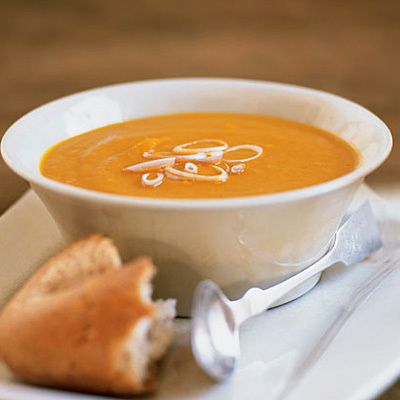
Curried Carrot, Sweet Potato, and Ginger Soup

curried-ginger-carrot-soup

This dish is a great way to get more vitamin A and beta carotene. Both the carrots and the sweet potatoes deliver oodles of both, making this recipe particularly good for both your skin and vision.

Pair it with a whole grain baguette for a hearty and satisfying meal.

Ingredients

  • 2 teaspoons canola oil
  • 1/2 cup chopped shallots
  • 3 cups (1/2-inch) cubed peeled sweet potato
  • 1 1/2 cups (1/4-inch) sliced peeled carrots
  • 1 tablespoon grated ginger
  • 2 teaspoons curry powder
  • 3 cups fat-free, less-sodium chicken broth
  • 1/2 teaspoon salt

Preparation

Heat oil in a large saucepan over medium-high heat. Add shallots; saute 3 minutes or until tender. Add potato, carrots, ginger, and curry; cook 2 minutes. Add broth; bring to a boil. Cover, reduce heat, and simmer 25 minutes or until vegetables are tender; stir in salt.
Pour half of soup in a food processor; pulse until smooth. Repeat procedure with remaining soup.


Sweet Potato Casserole RecipeSweet Potato Casserole

This rich and cozy dish is perfect for the holiday season, or really any time you need a hearty and healthy comfort food. The marshmallow and pecan topping will have kids (and adults!) clamoring for more.

To make this dish even healthier, use half-and-half instead of butter and lose two-thirds of the fat and half the calories. 

Ingredients

  • Potatoes:
  • 2 1/4 pounds sweet potatoes, peeled and chopped
  • 1 cup half-and-half
  • 3/4 cup packed brown sugar
  • 1 teaspoon salt
  • 2 teaspoons vanilla extract
  • 2 large eggs
  • Cooking spray
  • Topping:
  • 1 1/2 cups miniature marshmallows
  • 1/2 cup all-purpose flour (about 2 1/4 ounces)
  • 1/4 cup packed brown sugar
  • 1/4 teaspoon salt
  • 2 tablespoons chilled butter, cut into small pieces
  • 1/2 cup chopped pecans, toasted

Preparation

Preheat oven to 375°.
To prepare potatoes, place potatoes in a Dutch oven, and cover with water. Bring to a boil. Reduce heat, and simmer 20 minutes or until very tender. Drain; cool slightly.
Place potatoes in a large bowl. Add half-and-half, 3/4 cup sugar, 1 teaspoon salt, and vanilla. Beat with a mixer at medium speed until smooth. Add eggs; beat well (mixture will be thin). Scrape mixture into a 13 x 9-inch baking dish coated with cooking spray.
To prepare topping, sprinkle miniature marshmallows over top of casserole. Lightly spoon flour into a dry measuring cup; level with a knife. Combine flour, 1/4 cup sugar, and 1/4 teaspoon salt in a medium bowl. Cut in butter with a pastry blender or 2 knives until mixture resembles coarse meal. Stir in pecans, and sprinkle over potato mixture and marshmallows. Bake at 375° for 30 minutes or until golden brown.

Spicy Sweet Potato Wedges

Spicy Sweet Potato Wedges RecipeThese wedges should be baked at a high heat, which gives them a crispy, caramelized outside and a soft and tasty inside—no frying necessary!

This peppery dish pairs particularly well with roasted meat, and delivers all of your daily vitamin A along with one-third of your vitamin C. 


Ingredients

  • 6 medium sweet potatoes (about 2 1/4 pounds)
  • Cooking spray
  • 2 teaspoons sugar
  • 1/2 teaspoon salt
  • 1/4 teaspoon ground red pepper
  • 1/8 teaspoon black pepper

Preparation

Preheat oven to 500°.
Peel potatoes; cut each lengthwise into quarters. Place potatoes in a large bowl; coat with cooking spray. Combine sugar, salt, and peppers, and sprinkle over potatoes, tossing well to coat. Arrange potatoes, cut sides down, in a single layer on a baking sheet. Bake at 500° for 10 minutes; turn wedges over. Bake an additional 10 minutes or until tender and beginning to brown.

Buttered Sweet Potato Knot Rolls

rolls-ck-408839-xCute and tasty, these knot rolls are proof that you can use sweet potatoes in almost anything. What's more, this recipe contains only one-third the calories and fat of traditional knot rolls because of the sweet potatoes' natural sweetness. 


Ingredients

  • 1 package dry yeast (about 2 1/4 teaspoons)
  • 1 cup warm 2% reduced-fat milk (100° to 110°)
  • 3/4 cup canned mashed sweet potatoes
  • 3 tablespoons butter, melted and divided
  • 1 1/4 teaspoons salt
  • 2 large egg yolks, lightly beaten
  • 5 cups bread flour, divided
  • Cooking spray

Preparation

Dissolve yeast in milk in a large bowl; let stand 5 minutes.
Add sweet potatoes, 1 tablespoon butter, salt, and egg yolks, stirring mixture with a whisk.
Lightly spoon flour into dry measuring cups; level with a knife. Add 4 1/2 cups flour; stir until a soft dough forms.
Turn dough out onto a floured surface. Knead until smooth and elastic (about 8 minutes); add enough of remaining flour, 1 tablespoon at a time, to prevent dough from sticking to hands (dough will feel very soft and tacky).
Place dough in a large bowl coated with cooking spray, turning to coat top. Cover and let rise in a warm place (85°), free from drafts, 45 minutes or until doubled in size. (Gently press 2 fingers into dough. If indentation remains, dough has risen enough.) Punch dough down. Cover and let rest 5 minutes.
Line 2 baking sheets with parchment paper. Divide dough into 24 equal portions. Working with 1 portion at a time (cover remaining dough to prevent drying), shape each portion into a 9-inch rope. Carefully shape rope into a knot; tuck top end of knot under roll. Place roll on a prepared pan.
Repeat procedure with remaining dough, placing 12 rolls on each pan. Lightly coat rolls with cooking spray; cover and let rise 30 minutes or until doubled in size.
Preheat oven to 400°.
Uncover rolls. Bake at 400° for 8 minutes with 1 pan on bottom rack and 1 pan on second rack from top. Rotate pans; bake an additional 7 minutes or until rolls are golden brown on top and sound hollow when tapped.
Remove rolls from pans; place on wire racks. Brush rolls with 2 tablespoons butter. Serve warm or at room temperature.

Monday, February 4, 2013

How to cook the most delicious food in the world

Rendang:
Beef is slowly simmered with coconut milk and a mixture of lemongrass, galangal, garlic, turmeric, ginger and chilies, then left to stew for a few hours to create this dish of tender, flavorful bovine goodness.

An Indonesian dish made by simmering beef for hours in coconut milk and spices until the liquid has evaporated. It's then fried in the oil the meat releases, caramelizing what's left of the sauce around each piece of meat. 


Ingredients

Instructions

  1. Add all the salt, coriander, turmeric, ginger, garlic, shallots, and chili flakes to a food processor and run until there are no clumps left and you have a smooth spice paste. You'll need to scape the bowl down a few times.
  2. Add the oil to a heavy bottomed pot and heat over medium high heat until shimmering. Fry the beef in batches, allowing each surface to brown before turning. Transfer the browned beef to a bowl and repeat with the remaining meat.

  3. Beef Rendang
  4. Add the lemongrass, lime leaves and galangal to the hot oil and fry until fragrant. Transfer to the bowl with the browned beef, leaving the oil in the pot.
  5. Turn down the heat to medium low, and then add the spice paste. Fry, stirring constantly until very fragrant and most of the moisture has evaporated (about 10-15 minutes). If the paste starts burning, reduce the heat and add a bit of water. Add the coconut milk and palm sugar, and then return the beef and herbs to the pot, stir to combine the turn the heat down to medium low and loosely cover with a lid (you want some steam to escape). Stir the rendang periodically and simmer for 3-4 hours until the meat is very tender.
  6. Once the meat is tender and most of the liquid has evaporated (about 4 hours), remove the lid and turn up the heat. You'll need to stir the mixture constantly to prevent it from burning, but you want to evaporate as much liquid as you can without burning the meat. At this point there should be quite a bit of oil in the pot from the meat so you're essentially frying the sauce and concentrating the flavors.
  7. The rendang is done when there is almost no sauce left and the meat is dark brown. Ideally you'll let this sit overnight for the flavors to evenly distribute into the meat. During this time, the meat will turn chocolate colored and the flavors will deepen. Serve the beef rendang with steamed rice.

Fried rice is a popular component of Asian cuisine, especially in Southeast Asia, where it is staple as Southeast Asian foods. It is made from steamed rice stir-fried in a wok, often with other ingredients, such as eggs, vegetables, and meat. It is sometimes served as the penultimate dish in Chinese banquets (just before dessert). As a home-cooked dish, fried rice typically is made with leftover ingredients from other dishes, leading to countless variations.
The many popular varieties of fried rice have their own specific list of ingredients. In Asia, the more famous varieties include Yangzhou and Fujian fried rice. Elsewhere, most restaurants catering to vegetarian or Moslem clientele have invented their own varieties of fried rice including egg fried rice, Indonesian (spicy) fried rice and the ubiquitous "special fried rice".

Fried rice is a common staple in American Chinese cuisine, especially in the form sold as fast food. The most common form of American Chinese fried rice consists of some mixture of eggs, scallions, and vegetables, with chopped meat added at the customer's discretion, and usually flavored with soy sauce instead of table salt (more typical for Chinese-style fried rice). Fried rice made in American Chinese restaurants can vary in appearance, from a dark brown appearance often seen in East Coast establishments, to a light brown appearance often seen in Midwestern American Chinese restaurants. Fried rice is also seen in other American restaurants, even in cuisines with no native tradition of the dish. The dish is also a staple of Chinese restaurants in the United Kingdom (both "sit-in" and "takeaway"), and is very popular in the West African nations of Nigeria, Ghana and Togo, both as restaurant and as street food.

How to cook Fried Rice? 
Ingredients: 
2 cups uncooked long-grain white rice
2 eggs, beaten
2 teaspoons sesame oil
1/2 teaspoon salt
8 ounces boneless skinless chicken thighs, cut into 1/2 inch strips
6 ounces raw shrimp, peeled
2 tablespoons vegetable oil
2 tablespoons chopped garlic
1 medium onion, finely chopped
2 teaspoons finely chopped fresh gingerroot
1 tablespoon dried shrimp paste
1/2 teaspoon fresh ground black pepper
1 tablespoon chili bean sauce or 1 -2 teaspoon sambal oelek
1 tablespoon oyster sauce
1 tablespoon ketjap manis or 1 tablespoon dark soy sauce

Garnish

3 tablespoons finely chopped spring onions
1/2 cup fresh cilantro leaves, chopped

Directions:
1 Boil rice in plenty of salted water until cooked.
2 Rinse, drain and spread the rice to cool.
3 Do this at least two hours ahead, or preferably, leave overnight in the fridge.
4 Combine eggs with sesame oil and salt, and put aside (see below).
5 Heat wok or large frying pan over heat until hot.
6 Add oil, and wait until it is very hot and slightly smoking.
7 Add the onions, ginger, shrimp paste, garlic, and pepper, and stir-fry for 2 minutes, squashing the shrimp paste as you go.
8 Then add chicken and shrimp and stir-fry for a further 2 minutes.
9 Add rice and continue to stir-fry for 3 minutes.
10 Now add the chilli bean sauce or sambal oelek, oyster sauce and ketjap manis/dark soy sauce and continue to stir-fry for 2 minutes.
11 Finally, add egg mixture and continue to stir-fry for another minute.
12 Alternatively make 2 thin omelettes from the egg mixture ahead of time and cut into strips.
13 These can then be used as garnish on the finished dish.
14 Turn onto large serving platter and garnish with the spring onion and fresh cilantro, and serve hot.

You Might Also Like
Indonesian Pineapple and Celery Salad - Selada Nanas
Nasi Goreng - Indonesian Fried Rice. Recipe by ozzygirl
Easy Indonesian Fried Rice (Bumbu Nasi Goreng). Recipe by Yamakawa
My Version of Nasi Goreng (Indonesian Fried Rice)
By BatiksWindmillsAndTurbans
Vegetarian Nasi Goreng (Fried Rice). Recipe by Sharon123
Vegetarian Nasi Goreng (Fried Rice)